Often, yes — though not in the way people usually mean. Ants do not attract other pests. What happens is that ants and other pests are responding to the same underlying conditions, and ants are simply the most visible indicator.
An ant problem is worth treating as a diagnostic finding rather than an isolated nuisance.
Ants Are Sensitive Indicators
Ants forage widely, exploit resources efficiently, and are highly responsive to moisture, food availability, and structural access. When conditions in and around a building shift in a direction that favors pests, ants tend to register it first and most visibly.
They are also difficult to miss. A trail across a counter gets noticed in a way that silverfish in a crawl space never will. So ants often function as the alarm for conditions that were already supporting other things.
Shared Condition One: Moisture
This is the big one, particularly in a high desert climate where any reliable water source stands out sharply.
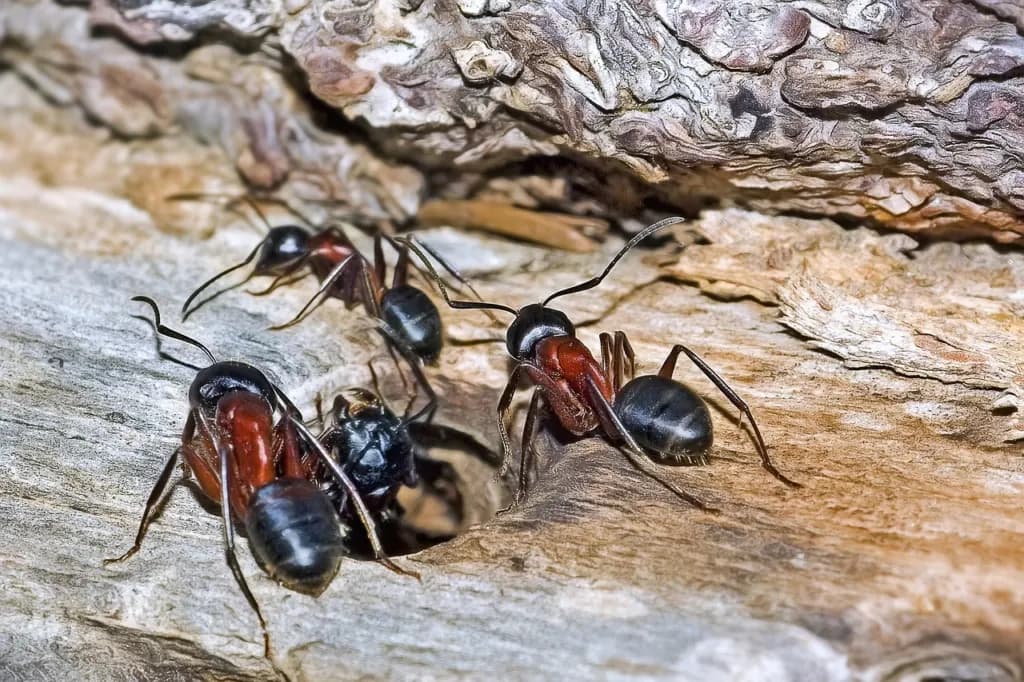
Many ant species — carpenter ants especially — are strongly associated with damp or water-damaged wood. A carpenter ant colony in a wall void is frequently a sign that water has gotten in somewhere and softened the framing.
The same moisture supports a long list of other pests:
- Silverfish and firebrats
- Springtails
- Earwigs
- Cockroaches
- Fungus gnats
- Spiders, which follow all of the above
If ants led you to a moisture problem, that moisture problem was almost certainly hosting other tenants.
Shared Condition Two: Accessible Food
Ants find food residue efficiently. Crumbs behind an appliance, a spill under a cabinet, an unsealed pantry item, pet food left out overnight, a bin that is not properly closed.
None of those attract only ants. Cockroaches, pantry beetles, flies, and rodents are all working the same resources, generally with less visibility. Rodents in particular are much better than ants at exploiting food sources without being detected.
An ant trail leading to a food source is telling you that source is discoverable and unsecured — information that applies to everything else in the neighborhood.
Shared Condition Three: Structural Access
Ants get in through gaps. Those gaps are rarely ant-specific.
- Gaps around window and door frames
- Unsealed utility, plumbing, and HVAC penetrations
- Foundation cracks and expansion joints
- Weep holes and siding gaps
- Roofline, soffit, and eave openings
- Poorly sealed garage doors
A quarter-inch gap admits a mouse. A gap ants use is often adequate for spiders, earwigs, box elder bugs, and small beetles. Tracing an ant entry point almost always identifies a vulnerability with broader consequences.
Shared Condition Four: Landscaping Contact
Vegetation touching the structure gives ants a bridge over any perimeter treatment. It does the same for spiders, wasps looking for nest sites, and rodents looking for roof access.
Mulch, dense groundcover, stacked firewood, and irrigated beds against the foundation create a continuous band of habitat directly against the building. Ants nest in it. So does a lot else.
Ants As A Direct Attractant
There is a smaller, more direct connection worth mentioning. Ants themselves are prey.
Spiders eat ants. So do centipedes and some beetle species. A large, sustained indoor ant population can support a predator population, which is why homeowners sometimes report spider activity increasing alongside an ant problem.
Some ant species also farm aphids and scale insects on landscape plants for honeydew, actively protecting those populations. That relationship can increase plant pest pressure in the yard, which in turn supports more insect activity overall.
What To Do With The Information
The practical implication is that treating the ants and stopping is a half-measure. The useful sequence:
- Trace the ants to their entry point and note it
- Follow the moisture — check under sinks, around water heaters, at exterior irrigation, and anywhere framing feels soft
- Identify what food source they found and secure it
- Inspect the areas the trail passes through for evidence of anything else: droppings, shed skins, webbing, frass
- Address the conditions, not only the ants
A thorough inspection prompted by an ant problem frequently turns up something the homeowner had no idea about. That is the point.
If you have ants in your Reno or Sparks home, contact Peak Pest Control at (775) 446-6199. We will treat the ants and inspect for what else the same conditions may be supporting.
Dealing with this pest at your place?
Peak serves Reno, Sparks, and northern Nevada with free inspections and a re-treatment guarantee. Get an honest quote, no pressure.
Aspen Chournos
Aspen Chournos writes about high-desert pest pressure and prevention for homes and businesses across Reno, Sparks, and northern Nevada.