Most ant work in northern Nevada is nuisance work: pavement ants coming up through a slab crack, odorous house ants trailing in off the landscaping, all of it annoying and none of it structural. Carson City is the exception, and the reason is the western boundary. Where Reno's west side runs into sagebrush, Carson City's climbs into pine and juniper below C Hill, and that puts carpenter ants genuinely on the table.
Carpenter ants don't eat wood. They excavate damp or decaying wood to nest in, which means finding them indoors is usually a moisture problem wearing a disguise. Woodpiles stacked against the house, old decking, a roof leak nobody quite got to, damp crawl-space framing. On the west side and the foothill benches those conditions are common, and a nest inside a structure needs locating rather than spraying.
The ordinary ant work still applies everywhere else in the city, and it follows the same high-desert logic as the rest of the region: ants move on water first, food second, so trails appear along foundations when the irrigation comes on and again during the driest stretch of summer. But the Carson City inspection always starts by working out which of the two conversations we're having, because the treatments are not the same.
Carson City isn't one pest problem, and it isn't one treatment either. These are the parts of the city where this service does the most work, and why.
West Carson & Kings Canyon
89703
Pine and juniper rather than sage, which makes carpenter ants a genuine structural concern rather than a curiosity. Woodpiles against the house, old decking, and unrepaired roof leaks are the three causes we find most, and a nest indoors here needs locating rather than spraying.
Downtown & the Kit Carson Trail
89701
Foundation gaps and a century and a half of plumbing penetrations in the 1860s stock give ants routes that no landscaping treatment touches. Damp historic framing also makes this the other part of the city where carpenter ants turn up indoors.
Eastside & the Carson River corridor
89701
Riparian ground that stays damp year-round in a valley that otherwise isn't. Ant activity starts earlier in spring and runs later into autumn here, and moisture rather than food is almost always what's drawing them indoors.
North Carson & Northgate
89706
Newer subdivisions with fresh landscaping and irrigation against modern slabs. Structures are sealed well, so the trail is the whole problem and the fix is outside in the beds and at the slab edge rather than under the sink.
High-desert pressure is seasonal and it's predictable. Knowing which window you're in is most of knowing what to book.
A late, compressed springApril – May
Carson City stays cold weeks longer than Reno, so ants surface late and then all at once. Sierra snowmelt saturates the western benches and the river corridor, and the first trails follow that moisture rather than the calendar.
Peak activityJune – August
Trails at their heaviest and carpenter ant activity on the west side at its most visible, with workers moving at dusk and coarse sawdust-like debris appearing below nest sites. This is the easiest window in which to actually locate a nest.
Indoors in winterDecember – February
Large black ants indoors during the cold months are the tell that matters here. It usually means a nest already inside the structure rather than something that wandered in, and it's an inspection rather than a spray.
If the pests come back, so do we.
Free re-treats between scheduled visits, no questions, no extra invoice. That’s the Peak Promise.
“Devan explained what product he was using for ant control and how it worked. I appreciated how polite and friendly he was.”
SS
Steve S.
Google review
“If I could give 100,000 stars I would! Gabe, Mikayla, and Devan took great care of us and we're already seeing progress against the ants. Fair pricing, fast scheduling, and friendly service.”
CS
Caileigh S.
Google review
“Best pest control company I have ever worked with. Peak took great care of my ants and my place.”
BA
Bella A.
Google review
From our blog
More on ant control in Carson City
Written for northern Nevada specifically, not generic advice pulled from somewhere with a different climate.
A thin line of ants on the counter is just the visible part of a much larger colony. Here's what spring ant trails reveal, and why pros target the source.
Damp areas and tiny gaps give pests the water and access they need to move in. Here's how moisture and entry points invite infestations, and what to check.
As nights cool, ant colonies shift toward warmth, food, and shelter, often indoors and out of sight. Here's the fall ant activity homeowners tend to miss.
Are carpenter ants actually a problem on the west side?
More than most people expect, and it's the genuine difference between Carson City and the rest of northern Nevada. Kings Canyon and the benches below C Hill are pine and juniper, and carpenter ants nest in damp or decaying wood rather than eating it the way termites do. Woodpiles stacked against the house, old decking, and roof leaks that never quite got fixed are the three causes we find most often.
I'm seeing big black ants indoors in January. What does that mean?
Usually that there's a nest inside the structure, and it's worth an inspection rather than a spray. Ordinary ants aren't foraging indoors in a Carson City winter. Carpenter ants in a heated wall void or damp framing will be, and killing the ones you see does nothing about the colony. Look for coarse sawdust-like debris below a void, and a faint rustling in a wall if it's quiet.
How do I tell carpenter ants from termites?
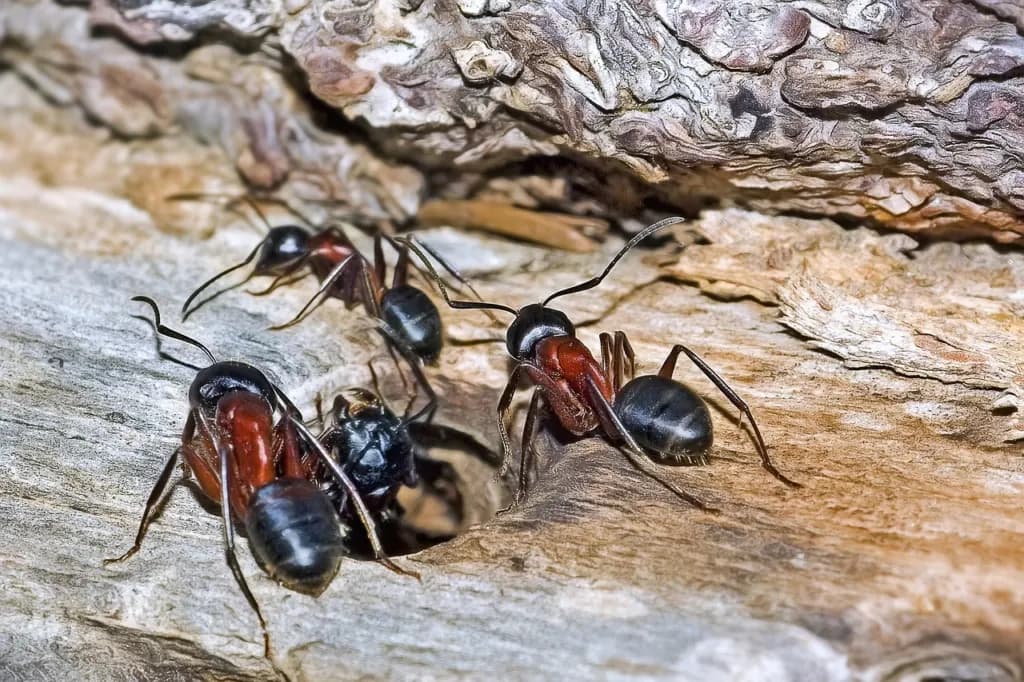
Carpenter ants have a narrow, pinched waist, bent antennae, and if they swarm, two pairs of wings of different lengths. Termites have a straight waist, straight antennae, and wings of equal length. The debris differs too: carpenter ants push out coarse shavings that look like pencil sharpenings, while termites leave the surface intact and hollow the wood from inside. Both occur here, and telling them apart is the first five minutes of the inspection.
Will treating the yard stop ants getting in?
In Northgate and the newer northern subdivisions, mostly yes, because the structures are sealed and the trail is the whole problem. Downtown and on the west side it's only part of the answer: 1860s foundations give ants routes that landscaping treatment never reaches, and a carpenter ant nest in damp framing is indifferent to anything happening in the beds.
How much does ant control cost in Carson City?
Ordinary ant work sits inside the recurring plans. Carpenter ants are quoted separately after an inspection, because the job is locating a nest and dealing with the moisture that made the wood attractive, which is a different piece of work from holding a perimeter. Most Carson City homes sit on one of our monthly plans: Pest Control at $65/mo (quarterly service), Pest + Weed at $125/mo (bi-monthly service), or Complete Property at $170/mo (bi-monthly service). Larger properties or heavy infestations can run higher, and we'll quote that up front after a free inspection.
What does an ant control visit in Carson City cover?
Every visit covers: species ID and nest/entry-point inspection; targeted baits, applied per label, that reach the colony; exterior perimeter treatment; free re-treats if the trail returns. What changes by address is the weighting. West Carson & Kings Canyon and Downtown & the Kit Carson Trail are two different jobs, so the technician decides on site where the time is best spent rather than running the same checklist everywhere.
Free Estimate
Ready to reach peak pest-free living?
Tell us what’s bugging you and we’ll get back to you fast with a free quote, usually the same day.