This distinction has real consequences. Honeybees are in decline, are protected in various ways, and should be relocated by a beekeeper rather than exterminated. Wasps generally should not. Getting it wrong means either killing pollinators unnecessarily or handling a defensive colony as though it were docile.
Body Shape
The fastest field mark.
Bees are robust and rounded, with visibly hairy bodies. The hair is functional, since it collects pollen. Honeybees are golden brown with darker banding. Bumblebees are large, very fuzzy, and boldly black and yellow.
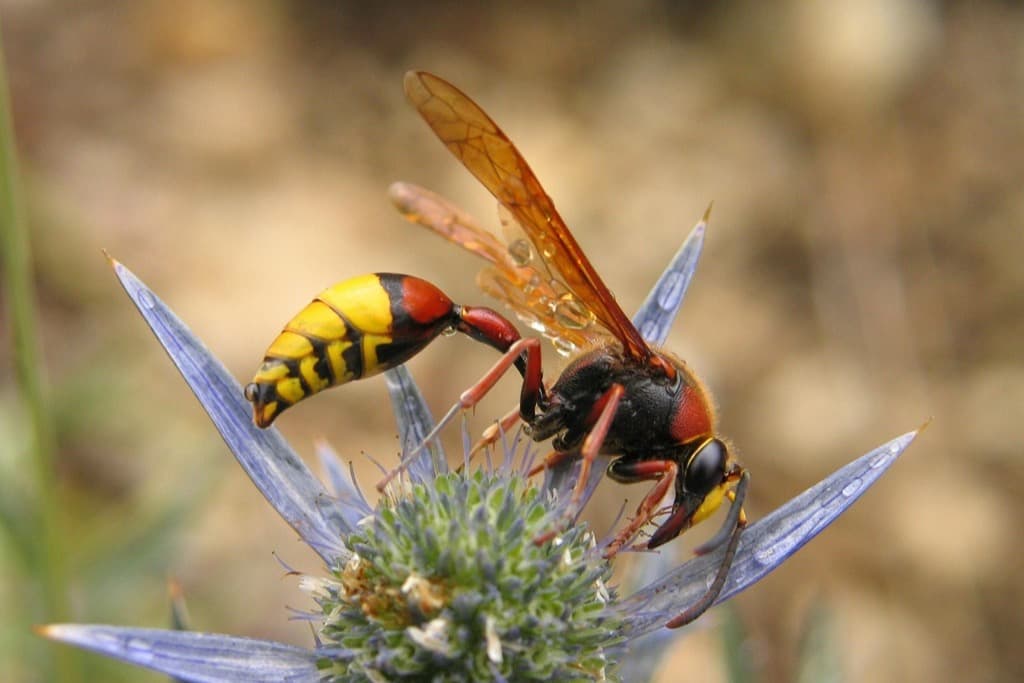
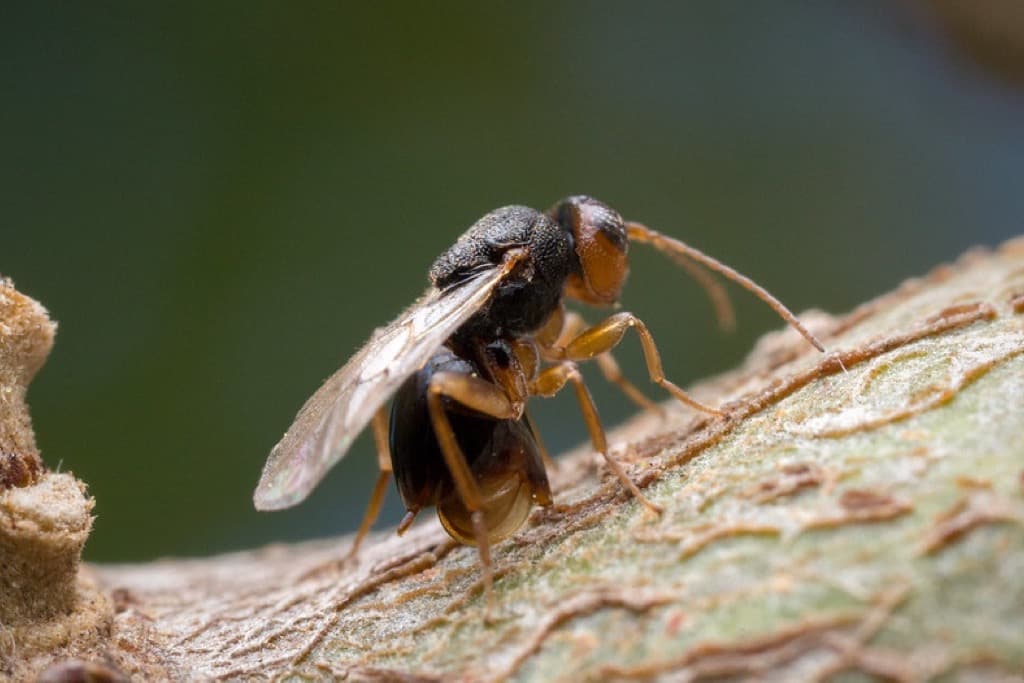
Wasps are slender and smooth, with a pronounced narrow waist between thorax and abdomen. Little to no hair. Colors are typically sharper and glossier: bright yellow and black, or black and white.
If it looks fuzzy and thick-bodied, it is almost certainly a bee. If it looks sleek with a pinched waist, it is a wasp.
Legs In Flight
A reliable secondary check.
Bees tuck their legs beneath the body while flying, and honeybees often carry visible orange or yellow pollen loads on their hind legs.
Wasps let their legs dangle. Paper wasps in particular have long legs that hang conspicuously, which makes them identifiable from several feet away.
Diet
Bees are vegetarian. They feed exclusively on nectar and pollen and will not come to your food.
Wasps are predators and scavengers. They hunt insects for protein and, in late summer, seek sugar aggressively.
This is the practical distinction that matters most: if something is landing on your soda, your sandwich, or your trash can, it is a wasp. Bees do not do this.
Nests
Honeybees build wax combs, usually in enclosed cavities, tree hollows, wall voids, chimneys, and occasionally attics. Colonies are large, often tens of thousands, and perennial rather than annual.
Bumblebees nest in small cavities, often underground in abandoned rodent burrows or under sheds. Colonies are small, a few hundred at most, and die off each winter.
Solitary bees, which are most bee species, nest individually in soil tunnels, hollow stems, or wood holes. Mason and leafcutter bees fall here. They are non-aggressive and highly beneficial.
Wasps build nests from chewed wood fiber that dries into paper. Paper wasps build open umbrella combs. Yellowjackets build enclosed nests underground or in voids. Bald-faced hornets build the large gray aerial nests. All are annual and die each winter.
Mud daubers build small mud tubes. Solitary and harmless.
Stinging Behavior
Honeybees have a barbed stinger that tears free when used, killing the bee. They sting only in genuine defense of the colony or when physically trapped. A single honeybee foraging on a flower is not a threat.
Bumblebees can sting repeatedly but are notably reluctant and generally have to be handled to do so.
Wasps have smooth stingers and can sting repeatedly. Social species defend a radius around the nest vigorously and, in the case of yellowjackets and bald-faced hornets, attack in numbers.
If you were stung once and found a stinger left in the skin, that was a honeybee. Multiple stings from one insect indicate a wasp.
Seasonal Behavior
Honeybee colonies persist through winter as a cluster. Swarms, which look alarming, are a colony dividing to reproduce. A swarm hanging on a branch is temporary and unusually docile, since the bees have no nest to defend. Call a beekeeper, not an exterminator.
Wasp colonies die each winter. Only fertilized queens survive, overwintering alone and founding new nests in spring. Nests are never reused.
What To Do With Each
Honeybees: contact a local beekeeper. Many will remove and relocate a colony, often at low or no cost, particularly for a swarm. Structural removals from wall voids are more involved and usually require a fee, but relocation remains the right approach. Do not spray them.
Bumblebees: leave them alone if at all possible. They are excellent pollinators, colonies are small, and they die off in winter. Relocation is worth considering only if the nest is directly in a high-traffic area.
Solitary bees: leave them entirely. Mason bees and leafcutter bees are valuable and essentially harmless.
Paper wasps: remove if near doors, walkways, or play areas. Leave nests that are well out of the way, since they provide real caterpillar control.
Yellowjackets and bald-faced hornets: professional removal, particularly for ground nests and anything after midsummer.
Mud daubers: leave them. They hunt spiders, including black widows.
When Identification Is Difficult
Some hoverflies and drone flies mimic bees convincingly and cannot sting at all. If it has only two wings rather than four and very large eyes, it is a fly.
If a colony is inside a wall and you cannot see the insects clearly, do not seal the entrance. If it is a honeybee colony, sealing it traps comb and honey in the wall, which then attracts other pests and can cause structural damage. Get it identified first.
If you have a nest or colony on your Reno or Sparks property and are not sure what it is, contact Peak Pest Control at (775) 446-6199. We will identify it and, if it turns out to be honeybees, point you to the right person to relocate them.
Dealing with this pest at your place?
Peak serves Reno, Sparks, and northern Nevada with free inspections and a re-treatment guarantee. Get an honest quote, no pressure.
Aspen Chournos
Aspen Chournos writes about high-desert pest pressure and prevention for homes and businesses across Reno, Sparks, and northern Nevada.