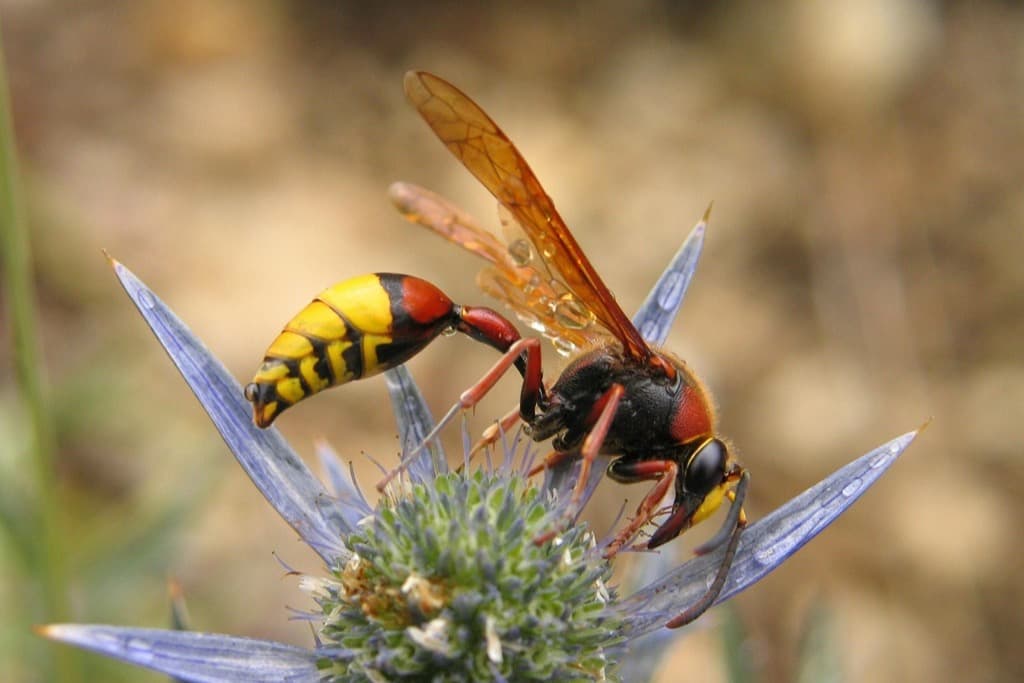
Hornets are not aggressive in the sense of seeking out people to attack. They are intensely defensive, which produces much the same experience if you happen to be standing in the wrong place.
The distinction is not academic. It tells you what triggers an attack and, more usefully, what does not.
Defensive, Not Predatory
A hornet foraging away from its nest has essentially no interest in you. Individuals gathering nectar, hunting insects, or collecting wood fiber will typically ignore a person entirely and can be walked past without incident.
The behavior changes completely near the nest. Hornets maintain a defended perimeter, and anything entering it is treated as a threat to the colony. That response is immediate, coordinated, and does not require you to have done anything deliberate.
Practically: distance from the nest is the variable that matters, not your intentions.
What Triggers A Response
Vibration. This is the big one, and the one that catches people out. Lawn mowers, string trimmers, leaf blowers, pressure washers, and power tools transmit vibration through the ground or structure. A colony reads that as an attack. Most serious incidents in residential yards start this way.
Proximity. Simply entering the defended radius is enough. For bald-faced hornets that radius can extend well beyond what most people would guess.
Rapid movement. Sudden motion near the nest, including swatting at an individual hornet, escalates quickly.
Nest damage. Any physical contact with the nest produces an immediate mass response.
Carbon dioxide and dark colors. Breath draws attention, and dark clothing tends to attract more defensive interest than light colors.
What "Bald-Faced Hornet" Actually Means Here
Around Reno and Sparks, the insect people call a hornet is almost always a bald-faced hornet — which is taxonomically a yellowjacket rather than a true hornet.
That matters because bald-faced hornets sit at the aggressive end of the range. They defend a larger radius than paper wasps, respond in greater numbers, and will pursue a perceived threat a meaningful distance from the nest. True European hornets, which are calmer, are not established here.
So the reputation is largely earned for the species people actually encounter.
Pursuit And Repeat Stinging
Two features make hornet defense more serious than a single wasp sting.
They do not lose their stinger. Unlike honeybees, hornets have a smooth stinger and can sting repeatedly. A single individual can deliver multiple stings in a few seconds.
They recruit. Disturbance triggers an alarm pheromone that draws additional colony members to the site, and that pheromone marks the target. This is why a disturbance rarely results in one sting — it results in several, from several insects, and why moving away from the area promptly matters.
Bald-faced hornets will follow a fleeing target, though pursuit distance is usually a matter of yards rather than the exaggerated figures that circulate online.
Seasonal Escalation
Defensiveness is not constant through the year.
Spring and early summer colonies are small and comparatively tolerant. A queen founding a nest in May is not going to mount much of a defense.
By August and September the colony has reached peak population, the nest represents an entire season of investment, and natural food sources are declining. Defensiveness rises accordingly, and so does scavenging behavior around people.
This is why the same nest that went unnoticed in June becomes a serious problem in September, and why late-season nest removal should not be attempted by homeowners.
If You Disturb A Nest
- Leave immediately. Do not stand still, do not swat, do not try to assess the situation.
- Move away in a straight line and keep going well past where the activity stops.
- Get indoors or into a vehicle if either is close.
- Do not jump into water. Hornets will wait.
- Protect your face and neck as you move.
Afterward, count the stings and monitor for symptoms. Multiple stings can produce a systemic reaction even in people without a known allergy. Difficulty breathing, swelling away from the sting sites, dizziness, or a rapid pulse warrants emergency care immediately.
Reducing The Risk
The reliable approach is early detection. A nest found in June is a small job. The same nest in September is not.
- Inspect eaves, soffits, sheds, and tree branches monthly through spring and summer
- Watch for consistent insect traffic to a single point — that is a nest whether or not you can see it
- Check the ground before mowing or trimming, particularly along edges and in overgrown areas
- Keep bins sealed and outdoor eating areas clean, which reduces scavenging traffic
- Do not seal a wall void entrance without treating first; the colony will move inward toward living space
Do Not Handle Established Nests
Consumer aerosol sprays are designed to be used from several feet away, which is inside the defended radius of an established hornet nest. That approach works on a small paper wasp nest in April. It goes badly on a mature bald-faced hornet nest in August.
If there is a hornet nest on your Reno or Sparks property, contact Peak Pest Control at (775) 446-6199. We will identify the species, remove it safely, and check for others you may not have found.
Dealing with this pest at your place?
Peak serves Reno, Sparks, and northern Nevada with free inspections and a re-treatment guarantee. Get an honest quote, no pressure.
Aspen Chournos
Aspen Chournos writes about high-desert pest pressure and prevention for homes and businesses across Reno, Sparks, and northern Nevada.