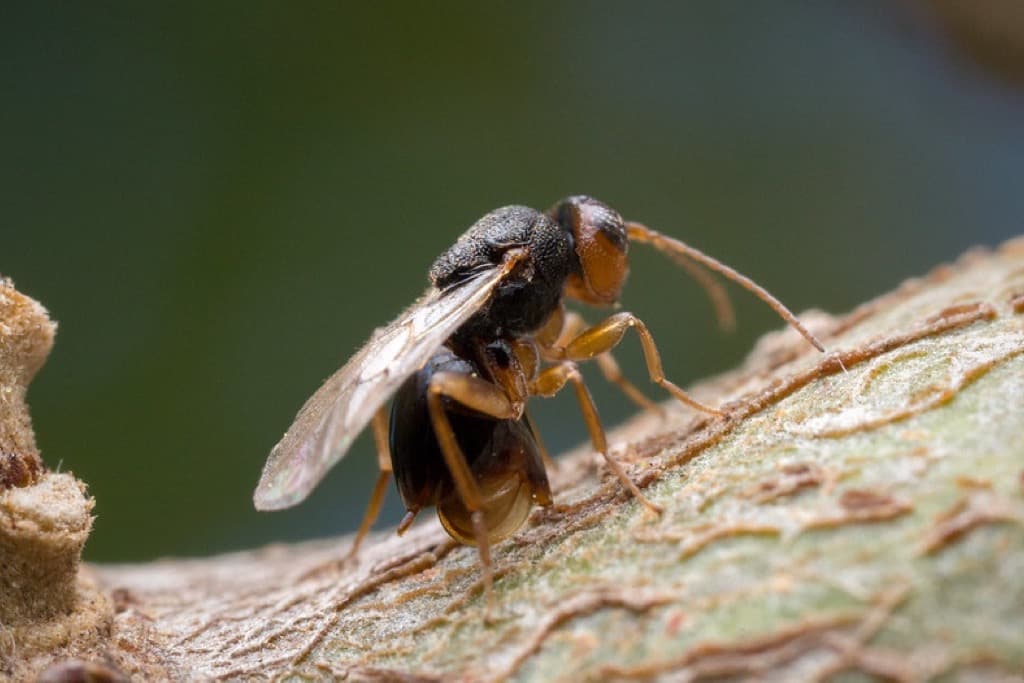
A wasp nest is a readable object. Its shape, location, and size tell you what species built it, roughly how many insects are inside, and how risky it would be to interfere with — all before you get close enough to find out the hard way.
How A Nest Begins
Nearly every nest you will find started with one insect.
Fertilized queens overwinter in sheltered spots — under bark, in wall voids, beneath siding, in leaf litter. In spring they emerge alone and select a nest site. The queen builds the first few cells herself, lays eggs, and raises that first brood without help.
Once those workers mature, they take over construction and foraging while the queen shifts to laying full time. Growth accelerates sharply from there. A nest that was the size of a walnut in May can be substantial by August.
At the end of the season the colony produces new queens and males, the new queens mate and disperse to overwinter, and the original colony dies with the first hard freezes. Nests are not reused the following year.
That last point has a practical implication: an old nest in winter is empty and harmless. It is worth removing anyway, because it marks a location the site conditions favor.
Reading The Nest Type
Open umbrella comb, no covering. Paper wasps. A single layer of visible hexagonal cells hanging from a short stalk. Colony small — usually well under a hundred. Least dangerous to be near. Found under eaves, in door and window frames, on porch ceilings, inside grills, in patio furniture, and in playground equipment.
Large enclosed gray teardrop. Bald-faced hornets. Fully covered in layered paper with a single opening near the bottom. Colony several hundred. Highly defensive. Usually suspended from a tree branch, large shrub, or eave, often ten feet up or higher.
Enclosed nest underground or in a void. Yellowjackets. Usually invisible — what you see is a steady stream of insects entering and leaving a single hole in the ground, a gap in siding, or a soffit seam. Colony can reach several thousand by late summer. The most dangerous type by a wide margin, because it is discovered by accident.
Small mud tubes on a wall. Mud daubers. Solitary, non-aggressive, and genuinely beneficial — they provision their cells with spiders. Not a threat, and generally worth leaving alone.
Where They Turn Up Around Reno Homes
Wasps select sites offering shelter from weather, protection from predators, and access to building material and food. In practice that means:
- Under eaves, soffits, and roof overhangs
- Inside wall voids, entered through siding gaps or utility penetrations
- Attics and crawl spaces
- Sheds, detached garages, and outbuildings
- Grills, patio furniture, and stored equipment
- Play structures and swing sets
- Tree branches and dense shrubs
- Underground, frequently in abandoned rodent burrows
- Behind shutters and inside meter boxes
- Around irrigation boxes and utility vaults
The concealed locations are the ones that cause trouble. A colony in a wall void may be substantial before anyone notices anything beyond occasional wasps indoors.
Signs Of A Nest You Cannot See
- Consistent insect traffic to one point on the structure
- Wasps indoors repeatedly, particularly at windows
- A faint rustling or papery sound inside a wall on warm days
- Staining on drywall or ceiling below a suspected void
- Increased activity around a specific area of the yard when mowing
Size And Timing
Nest size is a direct proxy for risk, and it climbs through the season.
April to May. Queen-founded, very small, minimal defense. The ideal removal window.
June to July. Growing, workers active, defense increasing. Still manageable for small accessible paper wasp nests.
August to September. Peak population, peak defensiveness, peak food-seeking. Professional handling only.
October onward. Colonies decline and die. Behavior can become erratic as food sources fail.
When Removal Is Safe To Do Yourself
A narrow set of conditions: a small paper wasp nest, early in the season, at or below shoulder height, in the open, with no one in the household allergic to venom, treated at night when the colony is inactive and clustered on the nest.
Outside those conditions, do not. Specifically never attempt:
- Any ground nest
- Any nest inside a wall, attic, or void
- Any bald-faced hornet nest
- Anything requiring a ladder
- Anything late in the season
- Anything at all if a household member has a sting allergy
The Wall Void Mistake
Worth calling out separately because it is common and the consequences are bad.
If wasps are entering through a gap in siding or a soffit, the instinct is to seal the hole. Do not. The colony is inside and will look for another exit — frequently through the interior wall, into the living space.
Treat first, confirm the colony is dead, then seal.
After Removal
Remove the physical nest where practical, since remaining pheromone can attract new queens to the same location. Clean the surface. Then address why the site was attractive: seal the gaps, screen the vents, and check the same locations again the following spring, because sites that suited one queen usually suit the next.
If there is a nest on your Reno or Sparks property — or traffic suggesting one you cannot see — contact Peak Pest Control at (775) 446-6199. We will identify it, remove it safely, and seal the access it was using.
Dealing with this pest at your place?
Peak serves Reno, Sparks, and northern Nevada with free inspections and a re-treatment guarantee. Get an honest quote, no pressure.
Aspen Chournos
Aspen Chournos writes about high-desert pest pressure and prevention for homes and businesses across Reno, Sparks, and northern Nevada.