
The terms get used interchangeably, and in casual conversation that is mostly harmless. When you are deciding how to deal with a nest twenty feet from your back door, the distinction matters — because these insects nest differently, defend differently, and require different handling.
The Taxonomy, Briefly
All hornets are wasps. Hornets are a specific group within the wasp family, distinguished mainly by size and by building large enclosed aerial nests.
The complication is regional naming. In North America, the insect most people call a "bald-faced hornet" is not a true hornet at all — it is a yellowjacket, taxonomically. True hornets in the U.S. are limited, with the European hornet being the main established species and largely absent from northern Nevada.
For practical purposes around Reno, what homeowners encounter falls into three groups: paper wasps, yellowjackets, and mud daubers.
Paper Wasps
Appearance. Slender, long-bodied, with noticeably long legs that dangle in flight. Usually brown with yellow or reddish markings. Roughly three quarters of an inch to an inch.
Nest. An open, umbrella-shaped comb of visible hexagonal cells hanging from a single stalk. No outer covering — you can see the cells and the wasps on them. Typically under eaves, in door frames, on porch ceilings, inside grills, and in play equipment.
Colony size. Small. Usually twenty to a hundred individuals.
Temperament. The least defensive of the three. They will sting to protect the nest, but the defended radius is small and they generally tolerate activity nearby.
Practical note. The most common nest homeowners find, and the one most likely to be in a location people brush past without noticing.
Yellowjackets
Appearance. Stockier and more compact than paper wasps, with bright, sharply defined yellow and black banding. Legs held close to the body in flight. About half an inch.
Nest. Fully enclosed, with a papery outer envelope and a single small entrance. Located underground in rodent burrows and soil cavities, or concealed in wall voids, attics, sheds, and dense vegetation. Often invisible until you notice the traffic at the entrance.
Colony size. Large. Several hundred to several thousand by late summer.
Temperament. Highly defensive. They respond to vibration and disturbance near the nest, attack in numbers, and can sting repeatedly. They also scavenge protein and sugar, which is why they show up at outdoor meals and around trash bins.
Practical note. This is the group responsible for the large majority of serious stinging incidents. Ground nests are especially dangerous because mowing or stepping near the entrance triggers a mass response with no warning.
Bald-Faced Hornets
Appearance. Larger and more robust, black with distinct white or ivory markings on the face and abdomen tip. Around three quarters of an inch.
Nest. The large gray teardrop-shaped paper nest suspended from a tree branch, eave, or shrub — the classic "hornet nest" image. Fully enclosed with a single opening near the bottom.
Colony size. Several hundred.
Temperament. The most aggressive of the three by a clear margin. They defend a substantially larger radius and will pursue a perceived threat well away from the nest.
Practical note. Despite the name, this is a yellowjacket. It behaves like one, only more so.
Mud Daubers
Worth mentioning because they are frequently mistaken for something dangerous.
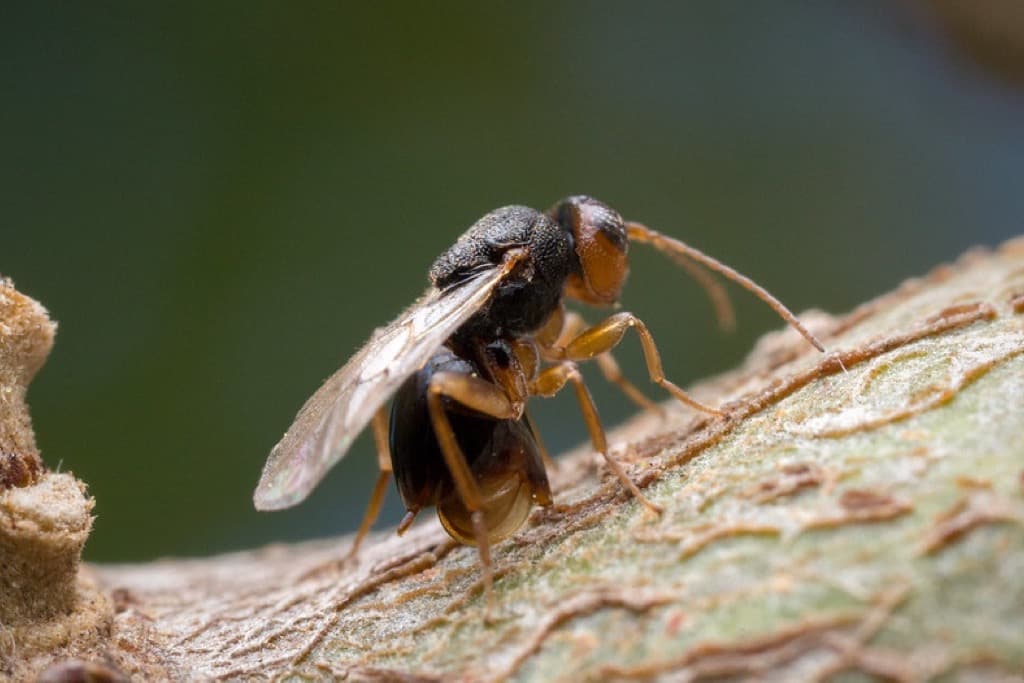
Appearance. Very slender with a thread-like waist, often metallic blue or black.
Nest. Small tubes or lumps of dried mud on walls, eaves, and sheltered surfaces.
Temperament. Solitary and essentially non-aggressive. They rarely sting.
Practical note. Mud daubers hunt spiders and are genuinely beneficial. Old mud nests are commonly reused by other insects, but the daubers themselves are not a threat.
The Differences That Actually Matter
Nest visibility. Paper wasp and bald-faced hornet nests are visible. Yellowjacket nests usually are not, which is why they get discovered by accident and why the discovery tends to be painful.
Defended radius. Paper wasps defend a few feet. Yellowjackets defend more. Bald-faced hornets defend considerably more and will follow.
Colony size and seasonality. All three peak in late summer, but yellowjacket and hornet colonies reach populations that make an accidental encounter genuinely serious rather than merely unpleasant.
Food behavior. Yellowjackets scavenge and will come to you. Paper wasps and mud daubers largely will not.
When To Call Rather Than Handle It
A small paper wasp nest in an accessible spot, addressed early in the season, is within reach of a careful homeowner.
Everything else is not. Specifically:
- Any ground nest, because the response is immediate and coordinated
- Any nest in a wall void or attic, because sealing the entrance drives the colony inward
- Bald-faced hornet nests at any size
- Any nest above head height or requiring a ladder
- Any late-season nest, when colonies are largest and most defensive
- Any situation where someone in the household has a venom allergy
If there is a nest on your Reno or Sparks property and you are not certain what it is, contact Peak Pest Control at (775) 446-6199. Identification is free, and it is a much better outcome than finding out the hard way.
Dealing with this pest at your place?
Peak serves Reno, Sparks, and northern Nevada with free inspections and a re-treatment guarantee. Get an honest quote, no pressure.
Aspen Chournos
Aspen Chournos writes about high-desert pest pressure and prevention for homes and businesses across Reno, Sparks, and northern Nevada.