"Wasp" covers an enormous range of insects, most of which are harmless and several of which are actively useful. Around Reno and Sparks, a homeowner realistically encounters five or six kinds, and they differ enough that lumping them together leads to poor decisions in both directions — panicking about something benign, or underestimating something that warrants caution.
Social vs. Solitary
The first and most useful division.
Social wasps live in colonies with a queen and workers, build shared nests, and defend those nests collectively. This group is where essentially all stinging incidents come from. Paper wasps, yellowjackets, and bald-faced hornets are social.
Solitary wasps live alone. Each female builds and provisions her own nest, has no colony to defend, and stings almost exclusively if physically handled. Mud daubers and most parasitic wasps are solitary.
If you can determine which group you are looking at, you have answered most of the practical question.
Paper Wasps
Slender, long-legged, brown with yellow or reddish markings, roughly an inch long. Legs hang visibly in flight, which is a reliable field mark.
They build the open umbrella-shaped comb — visible cells, no outer envelope — under eaves, in door frames, on porch ceilings, and inside anything sheltered and undisturbed. Colonies stay small.
Of the social wasps, these are the most tolerable neighbors. They defend a small radius and generally ignore nearby activity. They also hunt caterpillars in useful quantities.
Handling: A small, accessible nest early in the season is manageable. Nests in high-traffic areas — a doorway, a play structure — should come down regardless of size.
Yellowjackets
Compact and stocky with sharp yellow and black banding, about half an inch. Legs held tight to the body in flight.
They nest in enclosed spaces: underground in old rodent burrows, in wall voids, in attics, under sheds, in dense vegetation. Colonies reach several hundred to several thousand.
This is the group that causes problems. They are highly defensive, respond to vibration, sting repeatedly, and scavenge both protein and sugar — which is why they appear at barbecues and around bins in late summer.
Handling: Professional, always. Ground nests in particular should never be approached, because the response is immediate and there is no safe distance to work from with consumer products.
Bald-Faced Hornets
Larger and heavier, black with white markings on the face and abdomen tip. Around three quarters of an inch.
They build the large gray enclosed teardrop nest hanging from branches or eaves. Colonies reach several hundred.
Despite the name they are yellowjackets taxonomically, and they behave like a more aggressive version of one — larger defended radius, will pursue.
Handling: Professional, always, at any size.
Mud Daubers
Very slender with a distinct thread-like waist, often metallic blue-black. They build small mud tubes on sheltered vertical surfaces.
Solitary, non-aggressive, and beneficial — they stock their cells with paralyzed spiders, including black widows. They almost never sting.
Handling: Leave them. Scrape old mud nests off if the appearance bothers you, ideally in winter. They are one of the few pests genuinely worth tolerating.
Parasitic Wasps
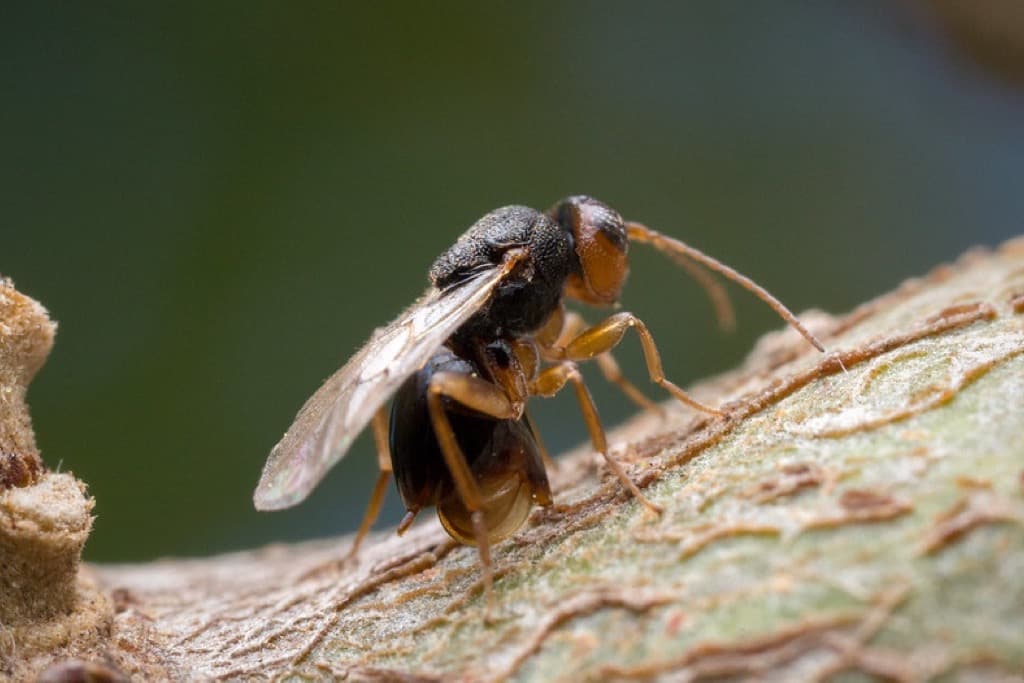
A large and mostly unnoticed group. Many are tiny. They lay eggs in or on other insects, and they provide substantial natural control of caterpillars, aphids, and beetle larvae.
Most cannot sting humans at all. If you have seen very small wasps around a garden and wondered whether to be concerned, this is usually what they are.
Handling: Leave them entirely. They are working for you.
Gall Wasps
Tiny, and noticed through their effects rather than directly — the round growths on oak leaves and stems are galls induced by these insects. They do not sting, do not enter structures, and do not meaningfully harm established trees.
Handling: No action needed.
Deciding What To Do
The question is not really which species it is — it is whether it is social, where the nest is, and how big the colony has grown.
Act when:
- The nest is social and near a door, walkway, play area, or work zone
- The nest is enclosed, underground, or inside a structure
- The colony is large or the season is late
- Anyone in the household has a venom allergy
- You cannot identify it confidently
Leave alone when:
- It is a mud dauber, parasitic wasp, or gall wasp
- It is a small paper wasp nest well away from foot traffic
The Beneficial Side
Worth stating plainly: wasps are significant predators of pest insects. A paper wasp colony removes a real quantity of caterpillars over a season. Blanket elimination of every wasp on a property is neither realistic nor desirable.
Good practice is targeted — remove what creates risk, leave what does not.
If there is a nest on your property and you would rather have it identified than guessed at, contact Peak Pest Control at (775) 446-6199.
Dealing with this pest at your place?
Peak serves Reno, Sparks, and northern Nevada with free inspections and a re-treatment guarantee. Get an honest quote, no pressure.
Aspen Chournos
Aspen Chournos writes about high-desert pest pressure and prevention for homes and businesses across Reno, Sparks, and northern Nevada.